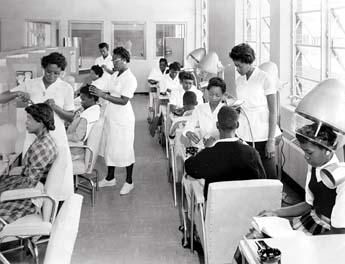
Greenwood was 35 blocks in north Tulsa. Hotels, beauty salons, law offices, a theater, a bus line, two newspapers, a hospital. Hundreds of Black-owned businesses built by people who arrived with land grants and law degrees and beauty school training and the specific understanding that they were going to build something that belonged to them. This is about the people who built it.
O.W. Gurley arrived in Tulsa in 1906 with a land grant and a plan. He was a graduate of Brown University -- one of very few Black men in the country who could claim that credential at the turn of the century -- and had taught school before deciding that land ownership was the more durable form of power. He purchased 40 acres in what would become the Greenwood District and began selling lots exclusively to Black buyers. That clause was not incidental. Gurley understood that economic segregation could be weaponized in reverse: if Black dollars stayed inside Black-owned property, the community could accumulate wealth rather than constantly transferring it out. He opened Gurley's Grocery, then the Gurley Hotel, then a rooming house, then a apartment building. By 1921 he owned more than $150,000 in real estate -- roughly $2.5 million in today's terms. He was not the wealthiest man in Greenwood. He was the one who made Greenwood possible for everyone else.
J.B. Stradford built the most valuable single asset in the district. Stradford had studied law at Oberlin and Indiana University Law School before moving to Tulsa, where he became convinced that collective Black wealth required Black-owned infrastructure. His answer was the Stradford Hotel, a 65-room establishment on Greenwood Avenue that was, at the time of its completion in 1918, the largest Black-owned hotel in the United States. It cost him $75,000 to build -- a number that required years of accumulated capital and credit that the mainstream banking system was designed to deny him. Stradford also owned rental properties throughout Greenwood and operated on a philosophy he stated openly: Black people should pool resources and do business with each other. He did not mean it as inspiration. He meant it as a business model, and he ran his own life according to it.
“Gurley did not wait for permission to build. He bought the land. He built the block. Then he sold lots exclusively to Black buyers and told them what he was building toward.”
Mabel B. Little opened her beauty salon on Greenwood Avenue before she was 30 years old. The details of exactly when the shop opened vary across historical records, but by the early 1920s Little's was an established institution -- a full-service beauty parlor serving the women of Greenwood at a time when beauty was one of the few professional industries with a clear pipeline for Black women, thanks in large part to the Madam C.J. Walker model that had spread nationally. Little's salon was not a side business. It was a destination. She had built clientele, trained staff, and established the kind of repeat patronage that sustains a small business through lean years. When the massacre came in June 1921, her salon was destroyed along with everything else. She and her husband Isaiah rebuilt. They reopened. Mabel Little continued operating in Greenwood for decades after the massacre, eventually living to 103 years old. She became one of the last living witnesses to both what Greenwood was and what it could be again.
Loula Williams owned the Dreamland Theatre, which opened in 1914 on Greenwood Avenue and seated 750 people. It was the entertainment anchor of the district -- the place where Greenwood residents saw films, attended performances, and gathered as a community outside of church. Williams built it in an era when Black audiences were either excluded from white-owned theaters or forced into segregated balcony sections. Dreamland was not a compromise. It was a full-capacity, Black-owned venue that put the full range of the entertainment experience in the hands of the community. Williams also operated a confectionery next door. Like Gurley, like Stradford, she understood that owning the building was different from renting space in it -- that the margin between those two things was the margin between stability and exposure.
Simon Berry ran what was effectively Greenwood's private transit system. He started with a jitney -- a car-for-hire service -- and expanded into a bus line that connected the Greenwood District to downtown Tulsa and the surrounding area. At a time when Black residents could not rely on municipal services designed with their access in mind, Berry built access himself. He also operated the Royal Hotel. His transit business gave Greenwood residents mobility that the city of Tulsa had not provided and would not have prioritized. It is the kind of infrastructure that does not make headlines but makes everything else possible.
By 1921, the Greenwood District contained more than 600 Black-owned businesses across those 35 blocks. Two newspapers. A hospital. Law offices. Dental offices. A library. A bus system. Thirty-five square blocks that had been built, brick by brick, by people who arrived with land grants and law degrees and beauty school training and a shared understanding that the alternative -- dependence on an economy that did not see them -- was not acceptable.
On May 31, 1921, a white mob entered Greenwood. By the morning of June 1, it was gone. Stradford's hotel: burned. Gurley's properties: burned. Mabel Little's salon: burned. The Dreamland Theatre: burned. Simon Berry's hotel and transit infrastructure: burned. The city of Tulsa denied insurance claims, rezoned Greenwood to block rebuilding, and filed no charges. The official death toll was listed at 36. Later investigations put the number closer to 300.
What the history books tend to skip is the third act. Mabel Little rebuilt. Gurley rebuilt. Greenwood's second iteration lasted into the 1960s, when urban renewal -- federally funded highway construction and redevelopment built on eminent domain -- finished what the massacre had not. The district was destroyed twice, by two different instruments. The founders are the reason there was a second time.
These are the names historians have been able to confirm. There were hundreds of businesses. Most of the owners remain unnamed in the public record -- their documents burned, their insurance claims denied, their stories still being recovered. The 2001 Oklahoma Commission report documented 191 destroyed businesses from insurance claims and survivor testimony. That report is the closest thing to a complete record that exists.
The Builders of Greenwood
O.W. Gurley
Real Estate, Gurley Hotel, Grocery
J.B. Stradford
Stradford Hotel (65 rooms)
Mabel B. Little
Beauty Salon, Greenwood Ave.
Loula Williams
Dreamland Theatre, Confectionery
John Williams
Williams Auto Garage
Simon Berry
Jitney Bus Line, Royal Hotel
Dr. A.C. Jackson
Surgeon
B.C. Franklin
Attorney
Andrew J. Smitherman
Tulsa Star Newspaper
Dr. R.T. Bridgewater
Physician
P.S. Thompson
Dentist
Dr. W.H. Heights
Physician
C.L. Netherland
Tailor Shop
Henry Jacobs
Grocery
Damie Rowland
Cleaning & Pressing
191 businesses documented by the Oklahoma Commission to Study the Tulsa Race Riot of 1921. Read the full report.